


Bachelor thesis

Aktualisiert: 23. Sept. 2025
For my bachelor thesis, I joined the core facaility antibodies at the DKFZ Heidelberg. There I started the production and validation of a mutation specific monoclonal antibody against BRAK V600E. This mutation occurs in 10–20% of melanomas and is associated with aggressive cancer progression. Early detection of this mutation can significantly increase survival rates—for instance, through the use of a mutation-specific, immunohistochemically applicable antibody like the one I worked on.
Production and validation of a mutation specific antibody against BRAF V600E
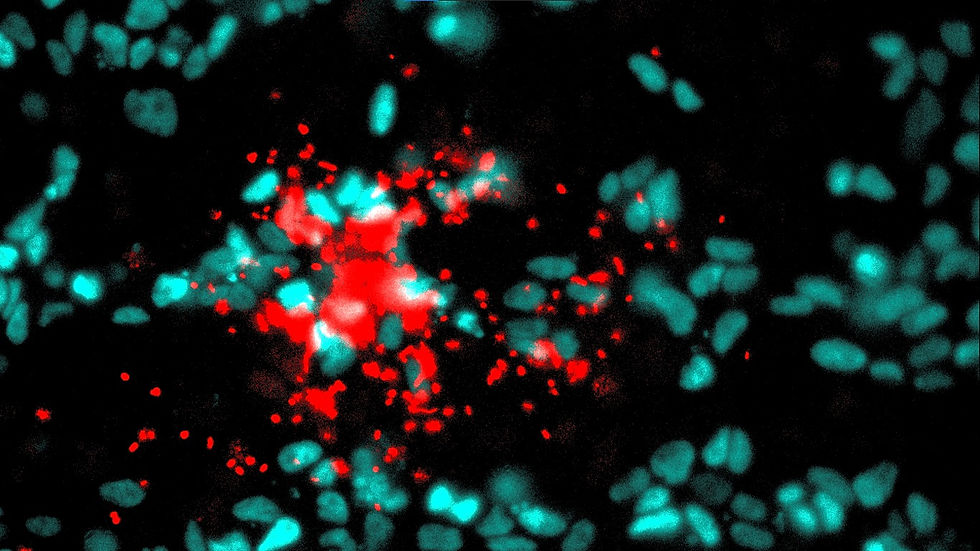
Signaling cascades enable cells to interact with the environment and respond to signals. Extracellular signals regulate pathways that influence important cell functions such as growth, proliferation, and differentiation. One of these pathways is the ERK/MAPK-pathway that is strongly involved in cell growth and proliferation as well as differentiation. The hyperactivation of this pathway plays an important role in the development and progression of malignant tumors. The kinase BRAF, an important component in the ERK/MAPK-pathway, shows a mutagenic increase in activity in about 50 % of melanomas, resulting in a hyperactivation of the ERK/MAPK pathway. In 70 – 90 % of BRAF mutations, the point mutation BRAF V600E is observed. As the second most common mutation, BRAF V600K occurs in 10 – 20 % of melanomas. If one of this two mutations are present, the drugs vemurafenib and darafenib can be used, thus significantly increasing the patients' chance of survival. Immunohistochemical detection using a BRAF V600E-specific monoclonal antibody is a rapid and very efficient method for detecting such a mutation. In case of a negative result, only a BRAF V600E mutation but no other BRAF V600 mutation can be excluded. Therefore, the aim of this thesis is to produce a monoclonal mutation-specific antibody against BRAF V600K. For this purpose, six mice were immunized and the lymphocytes of one mouse were fused with myeloma cells to obtain immortal hybridoma cells. A total of 3618 mother clones were screened against BRAF V600K overexpression by immunofluorescence. 115 of these mother clones were found to be positive and were further screened in immunohistochemistry and immunoblot also by BRAF overexpression, with 33 mother clones showing positive BRAF V600K signal in immunohistochemistry and 8 mother clones in immunoblot. 11 of these mother clones were subcloned. Subclone #60/11 showed a BRAF V600K-specific response in IHC in cells overexpressing this mutant protein. Subsequently, subclone #60/11 was validated and characterized on cell lines containing BRAF V600K, BRAF V600E, or BRAF wild type at endogenous levels. However, in the course of validation, subclone #60/11 had to be excluded as a BRAF V600K specific antibody. Since the subcloning of the other mother clones is still ongoing, within this project there is still a chance to identify a specific anti-BRAF V600K antibody that can be used in immunohistochemistry.

Further information
You can find more detailed information in my (German) bachelor thesis.

Kommentare